
Breaking the Silence: What they really need to communicate with confidence

In Pakistan today, speaking fluent English is often seen as a symbol of education, confidence, and professional credibility. For many young people, the ability to express themselves clearly in English isn’t just a language goal; it’s a life goal. Whether they’re preparing for international scholarships, trying to secure jobs at multinational companies, or seeking to stand out in university presentations, English communication has become one of the most sought-after soft skills among Pakistan’s emerging workforce.
At Nexus Angle, our mission is to help learners master communication, not through grammar drills or rote learning, but through real practice, real feedback, and real growth. To build a platform that truly addresses learners’ needs, we turned to the people themselves. We conducted a detailed survey with nearly 100 participants from across Pakistan. Our goal was to uncover what’s really holding learners back, what they’re hoping to achieve, and how they want to learn.
The Real Challenge: Confidence Over Grammar
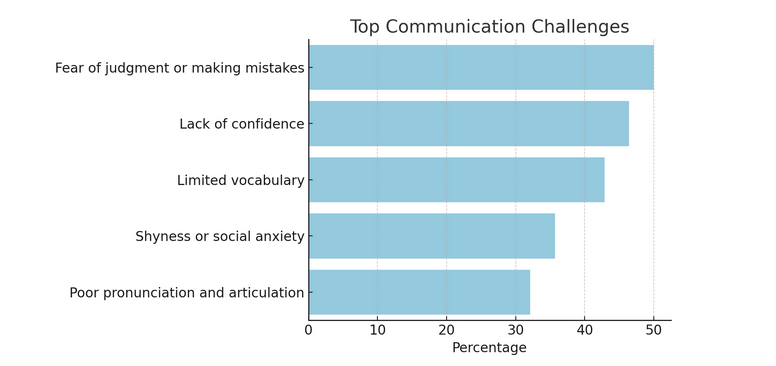
Contrary to common assumptions, most learners didn’t tell us that grammar or linguistic features were their biggest obstacle. Instead, the majority shared that emotional and psychological barriers like anxiety, fear of being judged, or lack of self-belief were far more limiting than their actual language knowledge. For many, the biggest hurdle wasn’t knowing the right words, but having the courage to use them.
One participant wrote, “I was presenting to my class after weeks of preparation. When I stood in front of everyone, I went completely blank. I knew the material, but I couldn’t express myself. It was frustrating to see confused faces because I couldn’t get the message across.”
Another added, “In my job interview, I felt like I didn’t have enough vocabulary to hold a proper conversation. I understood what they were saying, but I couldn’t respond confidently, and I lost the opportunity.”
The Why: Communication as a Gateway to Opportunity

So, what drives young Pakistanis to pursue English communication in the first place? According to our survey, it’s not just for exams or better grammar scores. Learners want to speak better English because they want more control over their futures. They want to secure high-quality jobs, present their ideas without hesitation, lead with clarity, and travel or study internationally with ease. They want to create, connect, and contribute; and communication is the key.
What Existing Solutions Failed to Deliver
While many participants had tried YouTube tutorials, apps, or traditional classroom programs, most found them lacking in real-life practice, interaction, and personalized feedback. The resources they tried often focused on passive consumption of grammar rules and vocabulary lists, or one-way instruction, rather than helping them improve fluency in meaningful, confident ways.
One participant expressed, “Most resources are designed only for passive learning. There’s no speaking or correction.”
“The methods I’ve used don’t give feedback, so I don’t know if I’m improving.” Commented another.
“No personalized evaluation. I don’t know where I make mistakes.” Another added.
Several respondents shared that current solutions lack opportunities to speak.
One stated, “Lack of regular speaking practice and confidence-building exercises.”
Another mentioned, “I didn’t find anyone to actually speak with, just watching videos isn’t enough.”
These quotes highlight a recurring frustration: learners need more than just content; they need conversation, feedback, and community. Nexus Angle’s approach to AI-guided real-time practice and instant feedback directly addresses these gaps, creating a space where learners can not only learn, but grow with confidence.
What Kind of Learning Works?
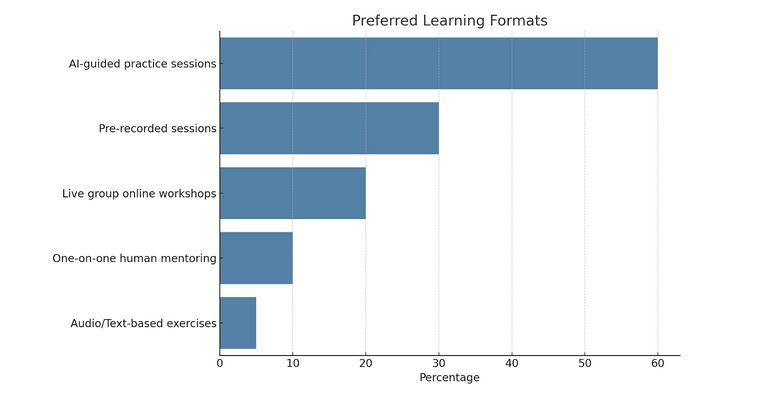
When we asked respondents what kinds of learning environments they preferred, they didn’t ask for traditional classrooms or textbooks. Instead, they asked for formats that are innovative such as AI-guided practice. Some also preferred pre-recorded sessions while few asked for peer sessions.
Is There Demand for a Platform Like Nexus Angle?
Absolutely. In our general survey, more than 60 percent of respondents expressed interest in joining an info session or beta test of our platform. These are not passive learners; they are motivated, open to feedback, and actively searching for better solutions. And they’re not just looking to improve their language skills; they’re looking to improve their lives.
How We’re Responding at Nexus Angle
We’re using these insights to shape every aspect of our platform. Learners can expect AI-powered speaking practice based on real-life tasks, live workshops to build confidence in small groups, goal-specific learning paths, microlearning modules to fit into busy lives, and low-cost access to ensure affordability and inclusion.
Our Mission
Communication is more than a skill. It’s a form of agency, a way to shape your future. In today’s world, thousands of bright, capable young people are being held back, not because they don’t know enough, but because they haven’t been given the space, support, and tools to grow. At Nexus Angle, we’re here to change that.
For more information, visit our website and social media channels